
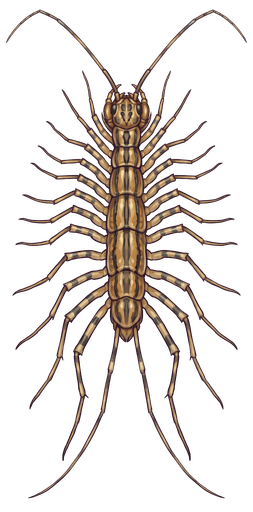
House CentipedeScutigera coleoptrata
About this species
- Length
- 3 in
- Wingspan
- 1.5 in
From our Collectors' field notes
Diet
This apex predator hunts exclusively in the dark and is highly efficient at exterminating roaches, silverfish, bed bugs, and termites. It is completely harmless to humans, acting as a free, silent pest control agent.
Defense
If a predator grabs one of their legs, the limb simply detaches and keeps twitching as a decoy while the centipede makes a getaway. Any lost legs naturally regenerate during the insect's next molt.
Lasso Legs
Instead of traditional biting jaws, house centipedes's front pair of legs are sharp, venomous pincers called forcipules. They use their many limbs to lasso prey, allowing the forcipules to inject a paralyzing venom.
Tangleproof
An adult has exactly 15 pairs of legs. Each pair gets progressively longer toward the rear of its body. This design prevents the legs from tangling when it breaks into a sprint.
Field Marks
Their longest pair of legs is at the very end of their body, acting as a decoy set of antennae. This clever disguise confuses predators into striking the wrong end.